.png)
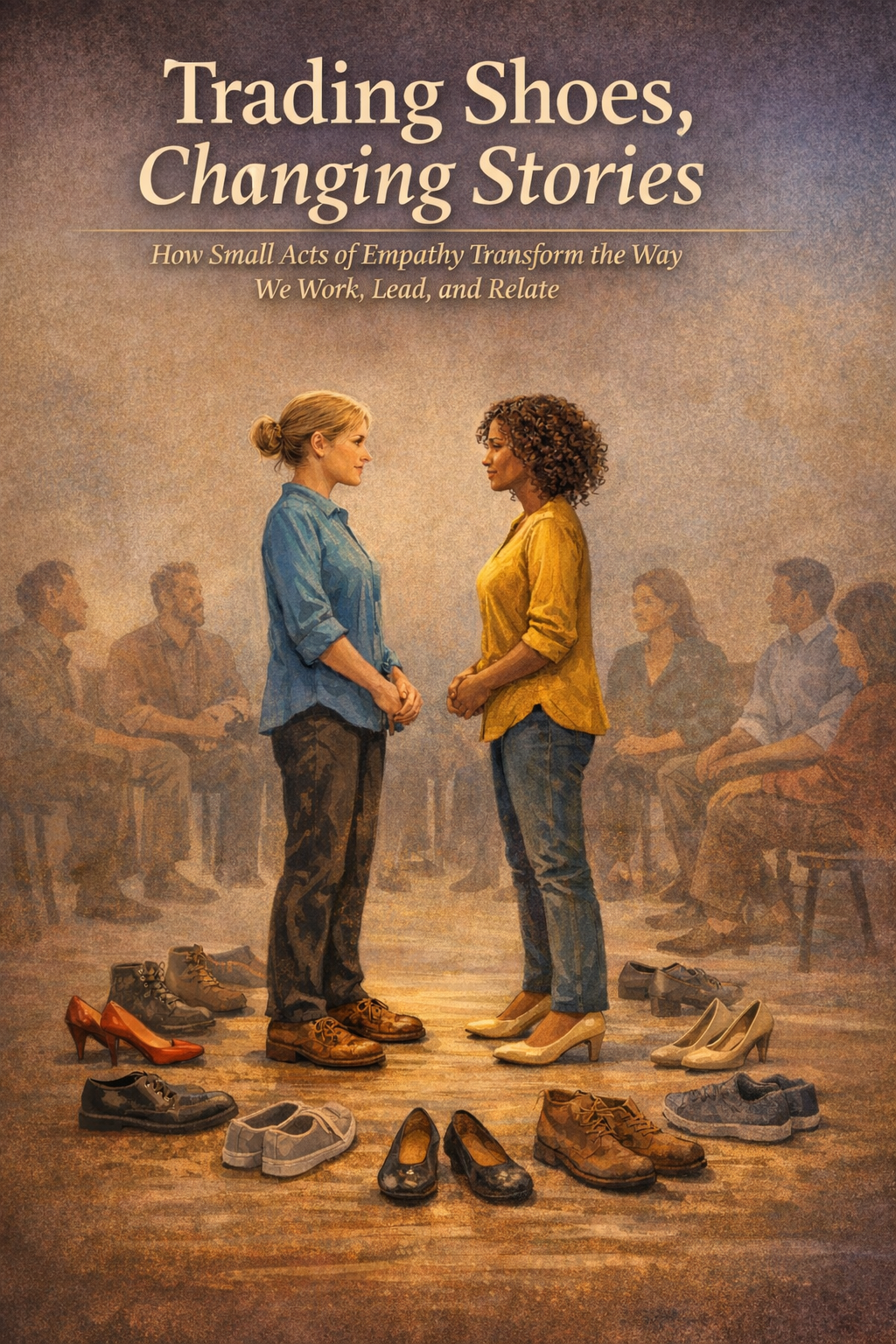


_On occasion, I work with teams who are at odds with one another. Sometimes, there is open hostility. Other times, it shows up as passive-aggressiveness.
Either way, it’s toxic. People are tense. Work suffers. The team may fracture into “us and them.” Productivity drops. Morale plummets. People begin looking for a way out — from the team, or even the company.
There’s a group exercise I use in these instances. One that, once I set up the instructions, causes the air to get sucked right out of the room. There is dead silence. Incredulous looks. Someone finally says what everyone is thinking:
“Are we really going to do this?”
I solemnly nod. And wait.
One by one, the team forms a standing circle. There are nervous twitters. Each person steps out of their shoes, places them on the floor in front of them, and awaits my next instruction.
The instructions are simple:
Leave your shoes where they are. Take four steps to the right. Stand behind another team member’s shoes.
The easy part is done.
What comes next is much harder. One by one, we go around the circle, with each person narrating what they believe it’s like to walk in the shoes they’re standing behind.
There is often hesitation.
Sometimes, a flash of understanding.
Other times, a visible discomfort as someone tries to name what they believe their peer’s experience on the team might be.
Then, the person who actually walks in those shoes responds.
Sometimes, they feel seen — and affirmed.
More often, they say, “That’s not quite it,” and share more color, more context, more vulnerability.
If I’ve done my job of creating a safe space, stories emerge — some raw, some painful, all illuminating. And as we go around the circle, something shifts. The conversation deepens. Insights unfold. It’s not unusual to hear:
• The co-worker resented for leaving at 4:30 is a single parent racing to daycare to avoid a $50 late fee and the tears of a two-year-old.
• The peer who hasn’t taken on extra work is already drowning in unrecognized tasks from another department.
• The “aloof” person who seems to think they’re better than everyone else is simply shy and deeply introverted.
• The teammate who says “no” at month’s end is buried in financial closeout work and barely keeping up.
What starts to emerge is a deeper truth:
The surface rarely tells the whole story.
As I do this work, I’m reminded of the story of a middle-aged man entering the NY subway in the early evening rush. Others are heading home after a full day's work, he has three pre-school age children in tow.
As the subway pulls out of the station, the children begin to make a ruckus, as only children can. They chase each other, bumping into weary travelers. They are boisterous and loud, disrupting the quiet many prefer on this ride.
It persists and yet the father appears indifferent. Not only to his children’s inappropriate behavior, but also to the sighs, the heads shaking in disbelief, the growing resentment of those around him.
Finally, one man brings the situation to a head. He directly asks the man if he wouldn’t mind asking his children to behave, so they stop bothering others on the train.
The inquiry startles the man into awareness, into the present. As he is calling to his children, he says, “I’m so sorry, sir. For you see, we’ve just left the hospital where my wife just passed, and I’m a bit out of sorts. I hope you’ll forgive my children and me.”
As you might imagine, that simple statement shifted things in an instant. From annoyance to understanding. From complaint to compassion. From judgment to grace.
I suspect you’ve had similar occurrences, where the story we “made up” about someone or something turned out to be totally inaccurate. In those times, we begin to realize:
• Most people are doing the best they can — at work and at home.
• We all make assumptions and rarely test them.
• And we’re all prone to a common mental trap: the actor-observer bias.
This bias leads us to explain our own missteps by pointing to external factors, but to blame others’ actions on internal flaws. In the subway example, YOU would have insisted that your children be respectful and considerate; HE was a lazy parent with no control over his own children.
Some other examples:
• You botch a meeting because of jet lag. They botch it because they’re careless.
• You submit a messy report because of bad data provided to you. They submit one because they’re lazy.
• You had good reason to be curt and direct. They were rude and an “A” hole.
When we are the actor, we know our story. When we are the observer, we guess — often unfairly.
But what if we paused before we guessed?
What if we chose to listen before we judged?
________________________________________
Walking in Another’s Shoes — Without Taking Yours Off
Sometimes, the simple act of seeing someone else’s truth is enough to shift a dynamic. I see. I hear. I understand. I soften. I change.
But awareness doesn’t always fix things. Sometimes, the truth uncovered requires action — a realignment of roles, redistribution of workloads, or a recalibration of expectations.
So the question becomes:
Without a facilitator asking you to take off your shoes… how can you practice empathy every day?
We’re wired to judge others more harshly than we judge ourselves. That’s the actor-observer bias at work.
We forgive our fatigue, our stress, our silence — because we know what’s behind it.
But when someone else drops a ball or pulls away, we assign blame.
Pause. Ask:
• What might I be missing?
• What else could be true here?
• If I were in their shoes, how might this feel?
Sometimes, just asking these questions opens a window where a wall used to be.
________________________________________
When we don’t know someone’s experience, we fill in the blanks. But the most radical act of empathy is simple: just ask.
Try:
• “How are things for you right now?”
• “I’ve noticed you’ve been quieter — anything I should know?”
• “I’m wondering how that deadline landed for you. Was it manageable?”
Ask with humility. Listen without planning your response.
The goal isn’t to agree. It’s to connect.
________________________________________
When someone’s actions create tension, it's easy to withdraw or lash out. But honest connection requires us to bring our truth — gently.
Instead of:
“You never follow through.”
Try:
“When I didn’t get your update, I felt out of the loop. Can we talk about how we stay aligned?”
Speak to impact, not intention.
You don’t know what they meant — but you do know how it felt.
________________________________________
Sometimes, empathy reveals changes that need to be made. New agreements. Greater flexibility. Or just acknowledgment.
Try:
• “How can we support each other better moving forward?”
• “What’s one small shift that would make a difference for you?”
• “Thanks for sharing that. It helps more than you know.”
Clarity is kind. Empathy is courageous. Connection is co-created.
________________________________________
You don’t have to take off your shoes to walk in someone else’s.
You can:
• Invite them for coffee or a walk.
• Shadow their day.
• Observe without judgment.
• Listen for what’s not being said.
• Ask a deeper question.
And when you do, something powerful happens.
The stories begin to change.
The assumptions dissolve.
And more often than not, they’ll be willing to walk in your shoes too.
________________________________________
I wore your shoes and walked a mile
They didn’t fit, they weren’t my style
They hurt a bit but made me smile
And when I’d worn them for a while...
I smelt your fear, I touched your dreams
I felt your hope, I heard your screams
We swapped our shoes one day in time
I found your way, and you found mine.
— Mark Bird
________________________________________
Choose one person you’ve been frustrated with.
• Before you label, pause.
• Before you speak, ask.
• Before you assume, listen.
• Before you judge, imagine.
And just maybe, walk a few steps in their shoes.
________________________________________
You're invited to subscribe to Ripples a soulful weekly newsletter crafted to nourish your inner knowing and spark meaningful insights. Each issue includes a short musing, reflection questions, and handpicked resources for your journey. If you're ready to reconnect, reflect, and rise in community with other spirit-led women, join us—and let the ripples begin.
Join my Ripples Newsletter
It’s been a hell of a day. I’m finally seventy miles in the air on a flight to D.C., then on to Indy — finally being the keyword.I’d spent the day in Savannah, Georgia, wrapping up a client’s strategic retreat. The plan was simple: finish by 4:30, get to the airport, and two-hop home to Indy by midnight. That was the plan — until it wasn’t.
Read this musing
Discover the hidden cost of “sacrifice syndrome” — the pattern of giving endlessly while neglecting yourself. Learn how renewal restores clarity, joy, and sustainable service.
Read this musing
As humans, we do these three things: We make up “stories” or versions of our truth using only our viewpoint and with limited and biased data. We assume our stories are factual, that we are right. We craft stories that put us in the best possible light. The stories don't always serve us - here is how to know!
Read this musing
Receive weekly insights from my years of lived experience as a creative, entrepreneurial woman stepping into my gifts and passions.
Join my Ripples Newsletter