.png)
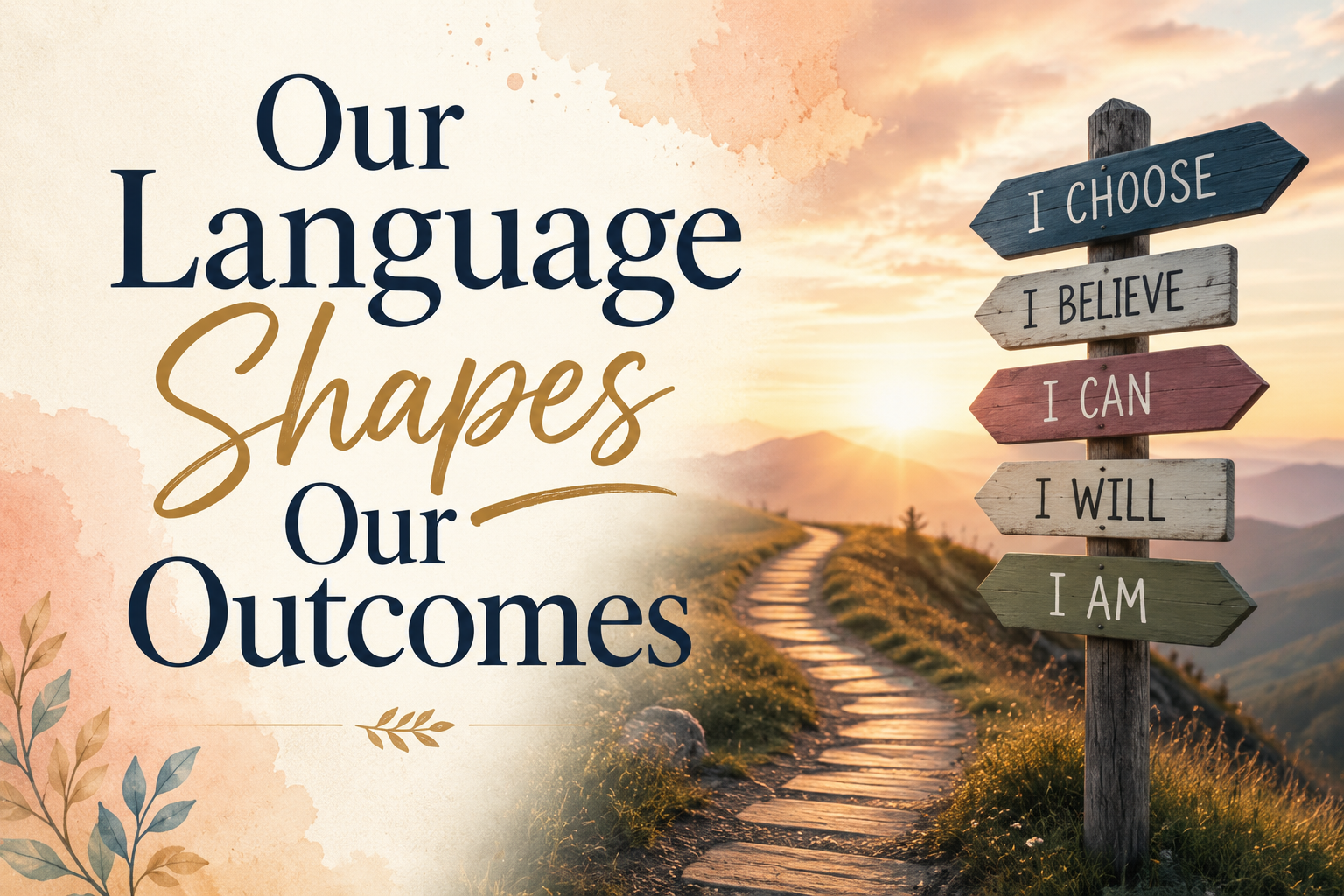


This is a story about my evolution.
Like most forms of meaningful growth, it didn't happen all at once. It unfolded gradually, one lesson at a time. Looking back, I wonder how I could have missed something so obvious for so long.
Early in my career, I was given responsibility for a complex project at a large manufacturing company. My team worked with experienced craftspeople to document their processes. Writers and designers transformed that knowledge into training materials. Then translators converted everything from English to Spanish for the company's first international operation.
It was a complicated undertaking with tight deadlines and many moving parts.
The craftspeople were far more comfortable with wrenches than words. The technical writers were meticulous and exacting. The translatorswere thousands of miles away and often unfamiliar with the specializedtechnical vocabulary.
My job was to keep everything moving.
I was good at organizing the work, securing resources, andencouraging people when the pressure mounted.
What I wasn't good at was navigating the endless debates over wording.
Every draft seemed to trigger another discussion. The content experts wanted one phrase. The editors preferred another. The translators raised concerns about meaning and interpretation. To me, it all felt unnecessary. We had a deadline. We needed progress, not perfection.
Then came the day I lost my patience.
In the middle of yet another discussion about word choice, I finally snapped. Frustrated and exhausted, I told the editor to just pick a word and move on.
"Words don't matter," I declared. "Action does."
I couldn't have been more wrong.
Over time, I came to understand that words are not separate from action. They shape action.
Words create clarity—or confusion. They build trust—or erode it. They invite people in—or shut them out. A single word can change how a message is understood, how a decision is made, or how a person feels.
Words matter.
And so do context, tone, timing, and delivery.
What I once dismissed as needless haggling was often aneffort to find the language that best conveyed meaning. The debate wasn't aboutwords. It was about understanding.
The irony is not lost on me. A younger version of myselfbelieved words were merely vehicles for action.
Experience has taught me they are often the steering wheel.
I was right that actions do matter – but here is why words matter. It is words that shape our thinking – and our thinking shapes our actions. Our words are subtle cues to ourselves and others. Words provide precision and also nuance. Words propel us forward or hold us back.
The right words create connection and shared meaning. Thewrong words create confusion and misunderstandings. But they do something evenmore powerful – and it took me a long time to learn that lesson.
My comeuppance on the power of words to shape our actions wouldnot happen until a decade later. And then it hit me hard and fast.
I was hosting Mary Lore (Mary Lore | LinkedIn), authorof Managing Thought: How do your thoughts rule the world? for a half-day workshop. I took pages of notes– but it was not her presentation that left the lasting impression on me. Itwas a participant’s visceral reaction to an exercise Mary had us do.
Mary asked us to write a list of our day-to-day tasks. Thingslike grocery shopping, laundry, cooking, making dinner.
Once we had the list, we said them aloud to a partner,prefaced by “I have to”. For example, I have to go to the grocery store. I haveto make dinner. I have to pack lunches.
She asked us to note how we felt. Words that surfaced includeddescriptors like overwhelmed. Irritated. Resentful.
Mary then asked us to repeat the exercises, this timesubstituting “have to” with “choose to”. And we did. Instead of “I have to goto the grocery store,” it was “I choose to go to the grocery store.”
In the readout, most people were startled by the shift intheir feelings. Just changing “have to” with “choose to” created an entirelydifferent set of emotions. Feelings of empowerment rather than powerlessness. Feelingsof agency rather than annoyance. Feelings of resolve rather than resentment.
That insight alone was a sticky one – that has helped me ever since.
Yet it was Susan’s reaction that drove the point home. One of her statements was that she had to pick her daughter up from school every day. When asked to state that she “chose” to pick her daughter up from school, Susan could not even utter the words aloud, even in this practice situation. She argued vehemently that there was no choice, only a must. No matter what it took, every day, no exceptions, no excuses. Just substituting that one word created a cascade of emotions – even in a practice situation.
There is a lot to unpack with her reaction – but I’ll leavethat to the experts.
What stuck with me was just how powerfully we respond to thechange of just one word – from “have to” to “choose to”. Susan’s reaction wasvisceral and visible. Yet for each of the other 29 people in the room, our reactionwas more restrained, but very evident in the emotional punch it packed.
Language is how we make sense of the world. How we translatethe outside into the actions we take. Just as a GPS gives different directionsdepending on the destination entered, our minds respond differently dependingon the words we choose.
Humans react differently when we say “have to” than saying“choose to”.
· When we say we “choose to”, rather than “we haveto” – we claim agency and choice
· When we say we “will”, rather than we “might” –we commit to action
· When we say we “are going to”, rather than we “needto” – we
· When we say “in the future, I will”, rather than“I wish I would have” – we set the stage for future action that is based onlearning from today
Mary provided us with a list of simple words to swap out.I’ve recreated it below.
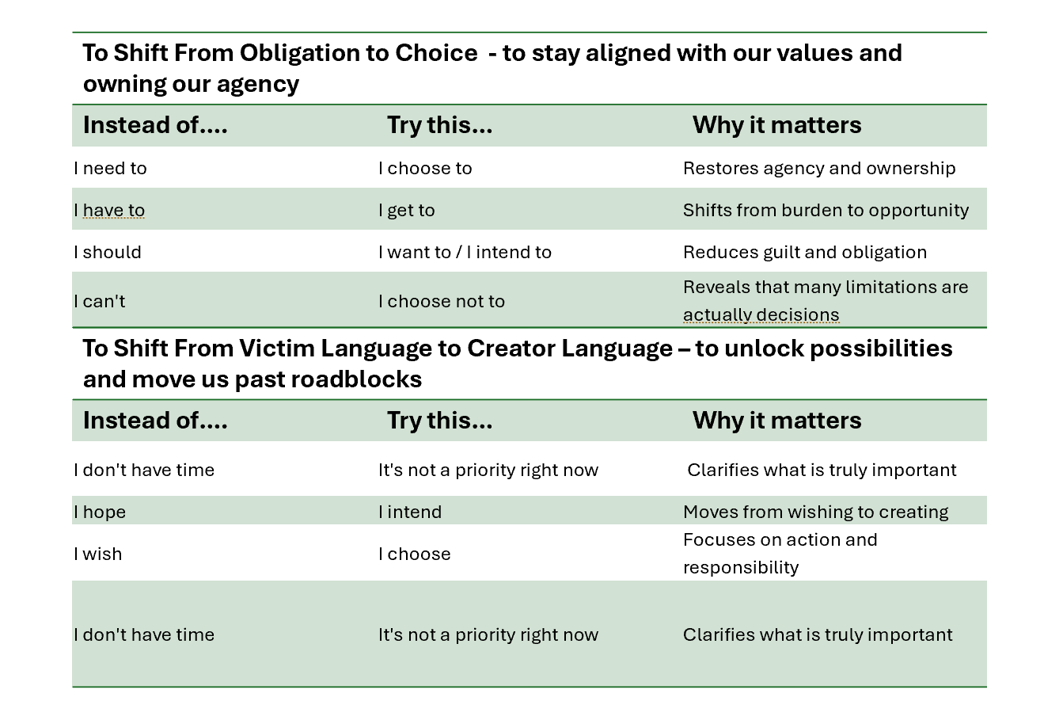
I’ve shared seven word substitutions for you. Begin bynoticing if any of the words need to, have to, should, can’t, hope, don’t havetime, or wish are default for you.
Now that you’ve noticed, catch yourself. Start to substitutethe more powerful word.
And then, notice again. How does that feel different? Howdoes that feeling translate into action? How does that action unfold?
I once believed words were merely vehicles for action.
Experience has taught me they are often the steering wheel.
My hope is that you reclaim the power of your words. Noticethem. Experiment with them. Change them deliberately. Then watch what happensas you put your hands on the steering wheel!
You're invited to subscribe to Ripples a soulful weekly newsletter crafted to nourish your inner knowing and spark meaningful insights. Each issue includes a short musing, reflection questions, and handpicked resources for your journey. If you're ready to reconnect, reflect, and rise in community with other spirit-led women, join us—and let the ripples begin.
Join my Ripples Newsletter
Exploring the places that tend to silence us: the Patriarchy at Work, at Home, at the Doctor’s Office, at the Gym, at Church or at the Car Dealership.
Read this musing
It’s Monday morning. 7 a.m. I sit at the kitchen table, gazing out at the dawn. It’s not quite light, but no longer dark. This in-between moment holds both the arrival of light and the retreat of night. And later, as the day dims into dusk, the cycle will reverse. This liminal time feels like a perfect metaphor for the emotions surrounding me lately. A reminder that opposites often co-exist — joy and despair, hope and fear, sadness and light. One woven into the other. One fades so the other may rise.
Read this musing.png)
A purely destination-driven life becomes transactional: work hard, defer joy, stay focused. A purely meandering life risks stagnation or circular wandering. But together? You aim toward something while allowing yourself to evolve along the way.
Read this musing
Receive weekly insights from my years of lived experience as a creative, entrepreneurial woman stepping into my gifts and passions.
Join my Ripples Newsletter